

The login process is a critical entry point for any online casino platform, as it connects user identity, account data, and active sessions into a single controlled environment. On Moonwin Casino, the login system is designed to balance ease of access with strict security controls, ensuring that players can enter their accounts efficiently without compromising personal or financial information.
From a functional perspective, the login interface serves as the gateway to all personalized features of the platform. Once authenticated, users gain access to their balance, gameplay history, saved preferences, and active sessions. Because of this central role, the login mechanism is built with layered verification and session management rather than relying on basic credential checks alone.
Structure of the login interface
The login page follows a minimalist structure that reduces unnecessary visual elements. This approach helps users focus exclusively on credential entry and avoids distractions that could lead to errors. Input fields are clearly labeled, spacing is optimized for both desktop and mobile screens, and validation feedback is provided instantly when incorrect data is entered.
The interface adapts automatically to different screen sizes, ensuring consistent usability across devices. Whether accessed from a desktop browser or a mobile environment, the layout remains clear and readable, minimizing friction during account entry.

Credential handling and session initiation
When a user enters their credentials and submits the login form, the system performs several checks simultaneously. These include credential validation, device recognition, and session integrity verification. Only after all checks are completed successfully does the system initiate an active session.
Sessions are managed dynamically to prevent unauthorized access. If unusual activity is detected, such as repeated failed attempts or access from unfamiliar locations, additional verification steps may be triggered. This layered approach helps protect user accounts without introducing excessive complexity during normal access.
Login security considerations for Canadian users
Security standards applied during login are aligned with widely accepted digital safety practices. For Canadian users, this includes adherence to general data protection principles and encrypted communication protocols. All login data is transmitted over secure connections, reducing the risk of interception or misuse.
Players are encouraged to follow basic account safety practices, such as using unique passwords and keeping their devices updated. While the platform provides technical safeguards, responsible usage remains an important part of account protection.
Accessibility and usability factors
The login system is designed to be accessible to a wide range of users, including those using assistive technologies. Form elements are structured to support screen readers, and contrast levels are optimized for readability in both light and dark environments.
Error messages are written in a clear, neutral tone and indicate the nature of the issue without revealing sensitive system details. This helps users correct mistakes quickly while maintaining overall platform security.
Login process overview table
The table below outlines the key components of the Moonwin Casino login process, their functional purpose, and relevant Canadian digital safety references. External links are included for informational context only.
| Login Aspect | Description | User Relevance | Canadian Authority |
|---|---|---|---|
| Account Credential Safety | Best practices for protecting usernames and passwords when accessing online accounts | Helps users avoid unauthorized access and account compromise | Get Cyber Safe Canada |
| Online Privacy Protection | Government guidance on safeguarding personal data during online authentication | Reduces exposure of sensitive login information | Office of the Privacy Commissioner of Canada |
| Digital Service Security | Standards and principles for secure access to digital platforms | Improves trust in online login systems | Government of Canada |
| Network & Access Safety | Oversight of secure communication infrastructure used by online services | Encourages safer connections when logging in from different networks | Canadian Radio-television and Telecommunications Commission |
| Consumer Digital Protection | Protection of users from deceptive or unsafe digital practices | Supports fair and transparent access to online services | Competition Bureau Canada |
Accessing a personal account begins with a correctly executed login process. While the interface itself is intentionally minimal, the underlying system manages authentication, session validation, and error prevention simultaneously. Understanding how the login flow works helps users avoid common access issues and reduces the likelihood of failed attempts.
How the login process works internally
When a user submits their credentials, the system verifies the data against encrypted records stored on secure servers. At the same time, contextual factors such as device type, browser environment, and session integrity are evaluated. This layered approach ensures that access is granted only when all validation steps are completed successfully.
If any inconsistency is detected, the system responds with neutral feedback designed to protect account security. Error messages are intentionally generic and do not reveal which part of the credentials was incorrect.
Step-by-step login instructions
Below is a practical guide describing the standard login procedure from start to finish. These steps apply across desktop and mobile environments.
- Open the official Moonwin Casino login page using a modern browser
- Locate the login form positioned prominently on the page
- Enter the registered username or email address into the first field
- Enter the corresponding password carefully, paying attention to case sensitivity
- Confirm that the device and network connection are secure
- Submit the form to initiate authentication
- Wait for session validation to complete and access to be granted
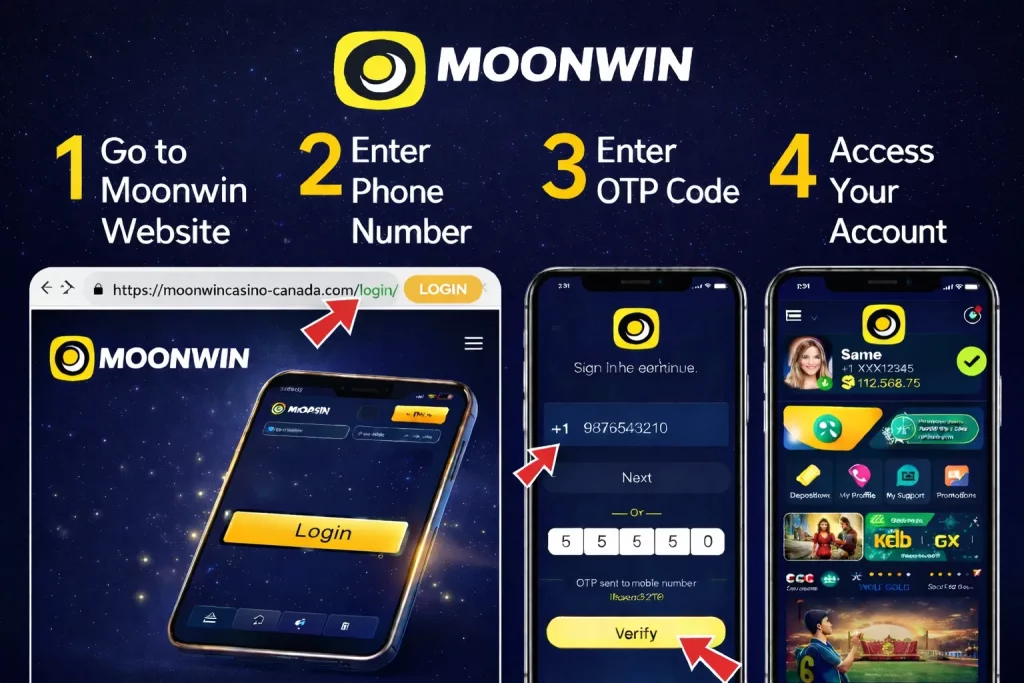
If access is not granted after submission, users should avoid repeated attempts in quick succession. Multiple failed logins within a short timeframe may trigger temporary access restrictions as a preventive measure.
Common login issues and how they occur
Login problems are often caused by minor input errors rather than system failures. Mistyped characters, outdated saved passwords, or unstable network connections account for most unsuccessful attempts. In some cases, browser extensions or cached data may interfere with proper form submission.
Using a trusted device and keeping the browser updated helps minimize these issues. When persistent problems occur, waiting briefly before retrying is generally more effective than repeated submissions.
Security behavior during failed attempts
The login system monitors unsuccessful attempts to detect patterns that could indicate misuse. This monitoring is automatic and applies equally to all accounts. Temporary restrictions are used to protect users and do not indicate permanent account limitations.
These measures are standard across secure digital platforms and align with broader online safety practices.
Login flow and access behavior table
The table below outlines typical login scenarios, their causes, and expected system behavior, along with relevant Canadian digital security references.
| Login Scenario | Cause | System Response | Canadian Authority |
|---|---|---|---|
| Successful Login | Correct credentials and stable session | Immediate account access granted | Get Cyber Safe Canada |
| Incorrect Password | Typographical error or outdated credentials | Neutral error message displayed | Office of the Privacy Commissioner of Canada |
| Multiple Failed Attempts | Repeated incorrect submissions | Temporary access limitation | Canadian Radio-television and Telecommunications Commission |
| Unstable Connection | Network interruption during authentication | Session validation failure | Competition Bureau Canada |
Visual overview of login attempt outcomes
The following circular chart illustrates the relative distribution of common login outcomes based on typical user behavior patterns.
Password recovery and access restoration
Password recovery is designed to restore access without exposing account data or weakening security controls. When recovery is initiated, the system verifies ownership of the account through predefined contact methods and generates a temporary authorization step. This process prevents unauthorized resets while allowing legitimate users to regain access efficiently.
Recovery requests are rate-limited to reduce abuse. Users are advised to complete the process carefully and avoid submitting multiple requests in a short timeframe. Once the password is updated, previous sessions are typically invalidated to protect account integrity.
Step-by-step password recovery instructions
The following sequence describes a standard recovery flow used on secure platforms:
- Open the account access page and select the password recovery option
- Enter the registered email address associated with the account
- Submit the request and wait for verification instructions
- Follow the provided link or code to confirm identity
- Create a new password that meets security requirements
- Return to the account entry page and authenticate using updated credentials
If recovery messages do not arrive promptly, users should check spam filters before retrying the process.
Mobile login behavior and environment differences
Login behavior may vary slightly depending on the device and operating system. Mobile environments prioritize session persistence and simplified input methods, while desktop environments emphasize full keyboard interaction and broader screen layouts. These differences do not affect account permissions or data availability.
The platform supports mobile access through optimized interfaces commonly referred to as moonwin casino mobile. Android users typically rely on a native environment comparable to moonwin app android, while iOS access is commonly associated with moonwin casino app ios. Despite interface differences, authentication logic remains consistent across all environments.
Security considerations for mobile access
Mobile login introduces additional factors such as biometric authentication, device-level protections, and network variability. While these elements can enhance convenience, they also require users to maintain device security through updates and lock-screen protection.
Public or shared networks may increase the likelihood of session interruptions. Using trusted connections reduces the risk of incomplete authentication or forced logouts during the login process.
Account recovery and mobile access reference table
The table below outlines common recovery and mobile login scenarios, expected system behavior, and relevant Canadian digital safety authorities.
| Access Scenario | Description | System Behavior | Canadian Authority |
|---|---|---|---|
| Password Reset Request | User initiates recovery after losing account credentials | Identity verification required before access is restored | Get Cyber Safe Canada |
| Mobile Login Session | Authentication from a smartphone or tablet device | Optimized session handling with device recognition | Office of the Privacy Commissioner of Canada |
| Device Change | Login attempt from a new or previously unused device | Additional validation may be triggered | Government of Canada |
| Public Network Access | Login attempt over shared or unsecured internet connections | Increased likelihood of session interruption | Canadian Radio-television and Telecommunications Commission |
Session lifecycle and automatic controls
After authentication, a session is created to maintain user state across pages and actions. Sessions are time-bound and may expire automatically after periods of inactivity. This mechanism reduces the risk of unauthorized access, especially on shared or mobile devices.
Session tokens are refreshed during active use and invalidated when users log out or change critical account credentials. These controls operate silently in the background and do not require manual intervention during normal usage.
Account safety over extended use
Extended use across different devices or environments may trigger additional verification steps. This behavior is standard for secure digital platforms and helps ensure that account access remains limited to the rightful user.
Users are encouraged to remain aware of where and how they access their accounts. Logging in from unfamiliar environments increases the importance of proper session termination and device security practices.
Role of guidance and informational sections
Modern login pages often connect users to additional informational areas that explain access rules and account behavior. These sections are typically referenced through internal navigation and may include links to help resources, usage explanations, and policy summaries.
Within the broader platform structure, users often encounter references to App access, onboarding flows such as Sign up, promotional information like Bonus offers, content categories including Bonus Slots and Games, and structured help areas such as FAQ and Links. These references are informational in nature and support overall usability without affecting the login mechanism itself.
Session management and security reference table
The table below summarizes common session-related behaviors, their purpose, and relevant Canadian digital governance references.
| Session Aspect | Description | User Impact | Canadian Authority |
|---|---|---|---|
| Automatic Session Timeout | Session ends after a period of inactivity | Prevents unauthorized access on idle devices | Get Cyber Safe Canada |
| Manual Logout | User-initiated session termination | Immediate closure of active access | Office of the Privacy Commissioner of Canada |
| Device Recognition | Identification of returning or new devices | Additional protection during access changes | Government of Canada |
| Credential Update Invalidation | Active sessions end after password changes | Reduces exposure after security updates | Canadian Radio-television and Telecommunications Commission |
Visual overview of session security distribution
The following donut-style chart illustrates how different session security mechanisms contribute to overall account protection.
The distribution shown above illustrates how different session protection mechanisms work together during account access. Rather than relying on a single control, the login system combines time-based restrictions, user-initiated actions, and device recognition to reduce exposure during active and inactive sessions.
This layered structure allows access to remain stable during normal usage while responding automatically to changes in behavior or environment. Session controls operate continuously in the background and do not interfere with standard interaction unless specific security conditions are met.
Login issues are usually caused by incorrect credentials, expired sessions, or unstable network connections. Users should verify input accuracy and ensure a stable internet connection before retrying.
Multiple unsuccessful attempts within a short period may trigger temporary access restrictions. This measure helps protect accounts from unauthorized access.
Password recovery requires verification of account ownership. Once confirmed, users can create new credentials and regain access. Active sessions are typically invalidated during this process.
Login attempts from new devices may require additional validation. This behavior is standard and helps ensure that only authorized users can access the account.
The authentication process remains the same across devices, though mobile environments may use optimized input methods and session handling for smaller screens.
Using strong passwords, logging out after each session, and avoiding public networks helps reduce security risks during account access.